Matrix Multiplication, Three Arithmetics
Every entry of a matrix product reduces a row-against-column list of candidates:
\[ (A \otimes B)_{ij} \;=\; \bigoplus_k \; A_{ik} \otimes B_{kj}. \]
The arithmetic decides what the reduction means. Ordinary arithmetic blends: every \(k\) contributes to the sum. Tropical arithmetic selects: one candidate wins the \(\min\) (or \(\max\)), and that winning \(k\) is a witness — the cheapest intermediate stop, or the binding constraint.
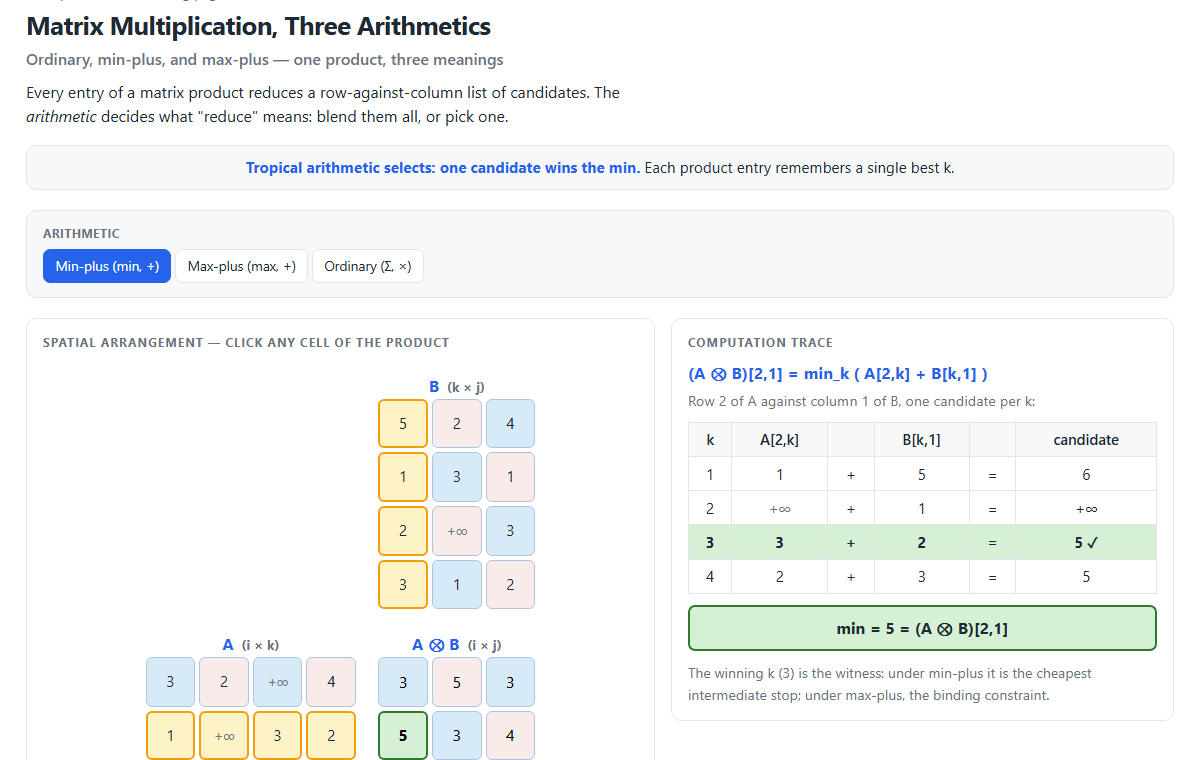
The inspector is a single self-contained HTML file. It runs entirely in your browser with no server, no network, and no dependencies — so the Download offline HTML link above gives you the same artifact to keep and open directly from disk.
What you can do
- Click any cell of the product: the contributing row of \(A\) and column of \(B\) light up, and the trace panel lists every candidate \(A_{ik} \otimes B_{kj}\) with the winner marked.
- Switch the arithmetic between min-plus, max-plus, and ordinary — same matrices, three different products.
- Watch the additive identity flip with the semiring: the same missing entries render as \(+\infty\) (min-plus), \(-\infty\) (max-plus), or \(0\) (ordinary) — in each case the element that contributes nothing.
This is the interactive twin of the paper’s Figure 2 (Section 3). The matrices are the figure’s exact matrices; the three product matrices are pinned as regression values in the artifact’s spec.
Supporting information
This page is supporting information for the tropical-algebra paper When Addition Becomes Optimization: Tropical Algebra, Paths, Schedules, and Semiring Computation (Section 3). It is designed to remain usable offline and is archived on Zenodo alongside the paper, where the five explorers ship together as a downloadable bundle.
Tropical-algebra mini-course
These five explainers read as a guided sequence — from the arithmetic, to the algorithms, to the hardware, to the cycle.